If you weigh 160 lbs or less, you may get a solo tandem experience. First, you take
a solo lesson. This teaches you the basics of launch and landing and crucial safety factors
involved in tandem flight. If the wind is right, you then experience mulitiple lower alitude
tandems or one higher alitude tandem. Since tandems require precise conditions for safety, we
may not be able to fulfill the tandem portion on the same day, but you will be contacted
when the conditions are right. Flexibility in scheduling is required. But anything worthwhile
takes some effort and desire. Cost: $220.00
For USHPA rated members wanting to review the latest launch and landing techniques or current
students under a USHPA instructor wishing to augment their current supervision. These interactive
presentations are a mixture of slide show, real video and animations that will help you understand, visualize
and practice all the basic hang gliding competencies. The instructional material here is without
equal anywhere in the world. You will be able to upload your own video of yourself so we can troubleshoot particular
problems and make solutions.
William Gasparek, FAA certified sailplane instructor says;
"Ask any conscientious instructor and he will tell you that learning to manipulate
the controls of an aircraft only takes a few hours. The difficult part is training the student to think about every aspect of the flight with safety and
situational awareness in mind. I fly paragliders and am learning to fly hang gliders. I am appalled that the majority of instructors simply teach how to
fly the hang glider. In many cases, the academic knowledge that is taught is little more than test prep for the USHPA written tests. So far, John's on-line
flight training is the only course I have found that teaches all aspects of how to actually fly safely. I strongly encourage all HG students, HG pilots and
HG instructors to take advantage of his on-line training regardless of where you fly. It could save your life."
Example classes include: Ground School, Flight Simulator Work, Transport-Assembly-Preflight, Ground Handling and Kiting, First Ground Runs
First Run-out Flights, Bar Pressures Feeling and Active Grip, Crosswinds and Gradients, Flared Landings, Risk
Managment. The USHPA and Ham Radio courses are free!
Register on the form to the left, but pay below
Cost: $15.00 ea/month for full access to this material
Have you and your instructor join us at OHGS Flight Concepts by subscribing now using the preferred payment method below. Provide a day or so get an invitational access link to the class. Email
john@oregonhanggliding.com.
A gmail account is required for this material.
Don't believe us. Please read the reviews of the program here:
http://g.co/maps/gx2sw
Over 40 flight proficiences in
four steps - Click Here! are learned in series and are suppported by an extensive instructional
infrastructure of privately leases training hills, fields, tow park, hangars, electronic simulators
bunk houses, and massage therapists. A noncommitted first introductory lesson is great fun! and is where
we start. Thereafter, decisions to pursue the sport or not is made. Each Lesson Step is purchased seperately
during the program with an associated personal equipment purchase to get the lesson discount price of $130
per lesson. Otherwise the lesson price is $150 per lesson.
Each step teaches wings leveling, straight and level flight, turnning flight and mountain flight respectively
in sequence. Each step has many detailed proficiencies outlined on the the following page. in
four steps - Click Here!. Radio communication, video review, tow training, parachute course and tandem instruction
is used in training. The cost of the training is significantly decreased because of the student's time and financial committment
and subsequent increase in effective learning. A Step Card is given each student to help track progress. There are
a number of days on one side of the card and list of proficiences on the other side. As you take a
step day, your proficiences are checked off. There is nothing mystical about the skill sets but
it takes a level of desire, priority and effort to attain them.
General Schedule
The lesson schedule is dictated by weather events. Therefore, email and twitter notifications are sent
a couple days before the lesson opportunity. When more than two or three days of consecutive good weather
is available, students are strongly recommended to take the opportunity progress quickly through a step and then return
home for book and online study. Arranging your lifestyle to be spontaneous and flexible during the training
program helps immensely. The other successful scheduling strategy is being unvarying in your committment to take a lesson on regular, consistent
basis no matter the weather conditions. This makes probabilities work for you. The worst strategy is take lessons on your arbitrary convienence counting
on the probability that wind conditions will be perfect. Generally, lessons are held at the inland training grounds Fall through Late Spring. Summertime
lessons are held at Newport, Or and Cape Kiwanda, Pacific City, Oregon. A scheduling contract of at least one lesson a month is strongly recommended with 3 day multiple
day "camps" being the optimium for steady progress in
learning.
Learn in Five Steps
It requires 14 lesson days or 84 hours over a three month, six month or year long lesson plan to learn how to competently
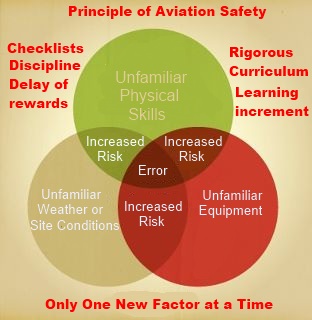
fly a hang glider. The OHGS program uses the philosophy of only one new factor at at time in the learning progression.
This is the secret to learning safely. Whether
it be a new skill, equipment procedure, or weather challenge, we leverage the piece-meal purchase of your advanced gear and its
integration to your skill-set to enhance the lesson and wean you off the more basic school equipment. So, by the time of the tenth lesson, we are figuring
out the final details of your flying system to create a totally competent beginner mountain pilot.
STEP ONE - Wings Level
This first milestone is huge. If one can keep wings level at all times in various conditions while standing, running or ground handling nothing
physically prevents one from becoming a hang glider pilot. Learn all about radios and communication on OHGSOnline, the web-based
interactive teaching material that acts as a complement to your textbook.
STEP TWO - Straight and Level Flight
Learn more advanced ground handling in different terrain effects. learn how to expertly carry and fly your glider like a kite for later close terrain flying. We make it so it
looks easy to others. Learn how to fly straight and level and vary pitch in various wind conditions. Learn to vary landing techniques based on conditions. Pass
the USHPA hang one flying proficiency and written test at home on OHGSOnline. Use your wind indicator to measure the challenges and begin
to hone your critical judgment
STEP THREE - Turning Flight
Learn how to manuveur left and right with better critical judgment. Hone your full flare stops to make the birds envious. Practice
with your custom made harness in the electronic simulator. Learn how to throw and pack your parachute. Assess your on-board video recorded
performance at home with the insructors dubbed critique.
STEP FOUR - First Altitude Maneuvers
Get oriented to your new glider - its assembly, care and extra speed on landing. Practice coordinated flight,
slow flight, fast flight, 360's and figure eights Recognize how to make an approach on a landing field.
; assess mountain conditions and general meterology; and use and pack your harness/parachute. More video review too!
STEP FIVE - Soaring Passes
Learn how to make soaring attempts by extending your
flight by using natural lift but recognize the limits and still land safely. Make use of your
variometer to tell whether you are being successful and record your flight to assess your performance
Payment Timing and Financing
The most successful students have a plan for the time and money. They also have a "long term" learning
mind-set since it the changes in the weather conditions and flying different sites which makes one
competent. Since the weather, the experience of new sites, brain-cell growth, and equipment cannot be rushed,
we strongly recommend a scheduling
contract and decide on a 3 month, 6 month or year long training time to get in the 14-15 day-sessions. A 2-3 day
lesson stint followed by home study is the perfect pace.
Taking day-sessons only when convienent
wastes time, money and encourages instructor inattention, lack of empathy,
and forgetfulness of your abilities.
The 3 month equipment
plan requires 50% of total equipment and instructional costs upfront. 6 month
plan requires 33.3% of total equipment and instructional costs upfront. The year plan reguires 12.5% upfront.
Most people start at 12.5% and quickly find the remaining 20.8% to get on the six month plan. That is how addicting
flying like a bird is!
With completion of the program, mentors are assigned to you and you receive continuing long term cell phone and
equipment support.
Hang gliding is the most cost effective way for fantastic flying pleasure, especially
in comparison to general aviation. Only slighty more cost than a private pilots license, you get all your
instruction AND your aircraft without the having to pay $100 rental per hour to fly. In hang gliding, once
you have your instruction and equipment, the costs are simply the fuel to get to a site and your yearly USHPA
membership fee.
Financing your program - all the equipment and instruction - can best be done by choosing the lowest interest rating card you can find. The following
link provides an application for a card that best suits your financial history. If you use the card only for
hang gliding the monthly payment is $150.00 - an amount entirely in the realm of most people.

If you are still confused why we don't pay for each day session. Please see more information at the following link: